
Let ancient architecture “breathe” at night! We spent two hours to rekindle the sense of reverence in the Great Hero Hall.
When ancient buildings dating back a thousand years meet modern lighting technology, how can we ensure the lighting both highlights the solemnity of religious architecture and conveys its cultural heritage? In the latest session of the "Lighting Designer Crash Course" salon, Mr. Song Te, Director of Solutions for Kujiale Lighting and Smart Business at Qunhe Technology, used the Great Hero Hall as a case study to demonstrate step-by-step the efficient workflow of the Koolux lighting design software—from model import to light rendering—unlocking the core principles of lighting religious buildings.
Design Logic: Building Light-and-Shade Layers Around the "Visual Center"
The soul of religious building lighting lies in precise control of atmosphere. Mr. Song Te emphasized that "solemnity, reverence, and clear layering" are the core principles:
• Visual Focus First: Centered on the plaque of the Great Hero Hall, use 2200K ultra-low color temperature Floodlights to highlight the focal point, with illuminance maintained at 300–500 lux to create a visual anchor;
• Gradual Color Temperature Reduction: Moving outward from the center, transition the color temperature from 2200K (warm golden yellow) to 3500K (neutral white), avoiding abrupt color shifts;
• Distinct Light-and-Dark Layers: The main facade receives the highest illuminance, followed by brackets and pillars, while steps and corridors feature subtle accent lighting, forming a three-tier brightness distribution of "center-secondary-atmosphere."
Through this design approach, even complex ancient architectural structures can present clear primary and secondary light-and-shadow effects with a profound sense of sacredness at night.
Hands-On Tools: An Efficient Workflow—1 Second Simulation, 2 Seconds for Drawings
As a domestically developed professional tool, Koolux's capability of "1 second simulation, 2 seconds for drawings, 30 seconds to generate a professional report" was thoroughly validated during practical application:
1. Seamless Model Synchronization: Supports direct import of models from upstream software such as 3D Max, with real-time synchronization of material and structural modifications, eliminating redundant modeling work.
2. Intelligent Lighting Assistance: Utilize the "Path Lighting" function to quickly generate light strips or arrays of Floodlights along brackets, steps, and other structures, supporting batch adjustments of angle and color temperature;
3. Real-Time Rendering Feedback: When adjusting lighting parameters, the scene updates instantly without waiting for lengthy renders, allowing designers to verify ideas immediately;
4. Quick Multi-Scene Switching: Generate lighting modes such as "Solemn and Reverent," "Dharma Assembly Celebration," "Moonlit Ambiance," and "Energy-Saving Watch" with one click to meet diverse temporal needs.
Taking the Great Hero Hall case as an example, from model import to completing the full lighting scheme takes only 2 hours, improving efficiency by more than 60% compared to traditional software.
Advanced Techniques: Collaborative Design of Materials and Lighting
The textural details of ancient building lighting often depend on the interaction between materials and light:
•Transparent Material Treatment: For transparent or semi-transparent materials like leaves and carvings, adjust "Transparency Channel Maps" and "Bump Maps" to prevent white film or distortion during rendering;
• Ground Material Optimization: Large-area materials such as grass and stone require "UVW Unwrapping" to ensure natural texture mapping proportions, enhanced with "Bump Maps" for increased tactile depth;
• Glare Control: Religious buildings should avoid direct strong light; achieve soft lighting effects by adjusting luminaire angles (e.g., projecting brackets at 45 degrees) and reducing ambient light reflection intensity (recommended 0.2–0.5).
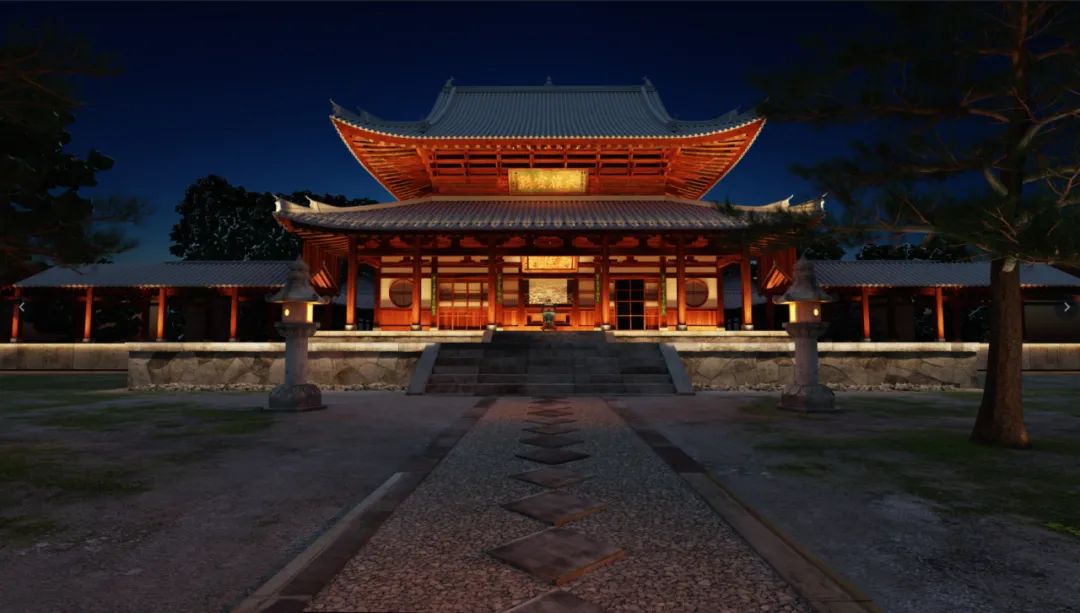
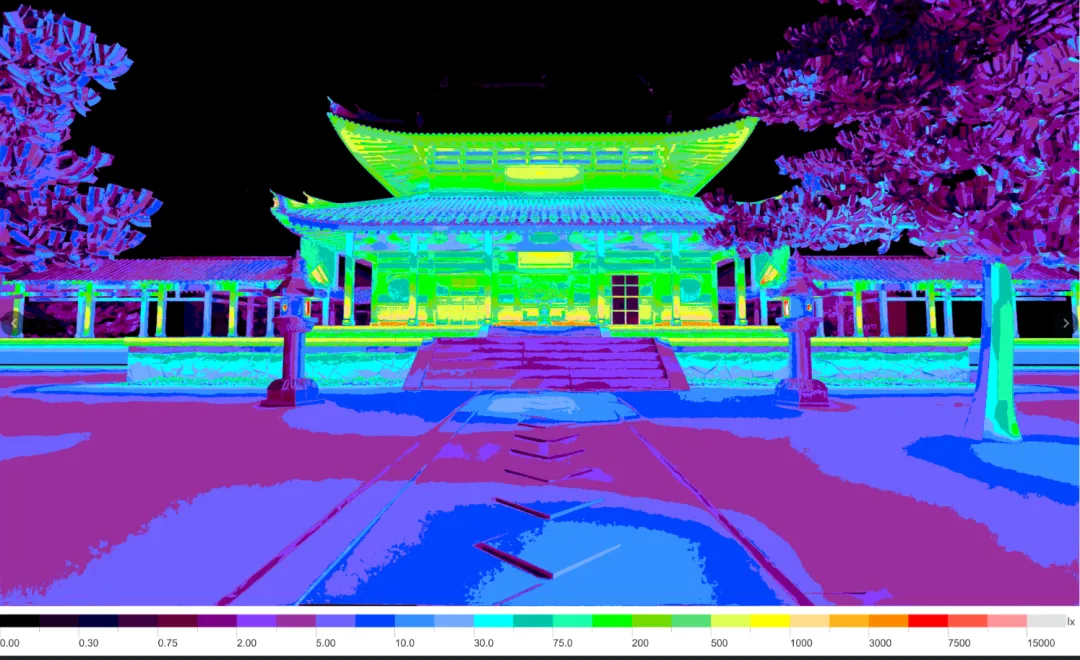
Great Hero Hall—Case Demonstration
Scan to View
Great Hero Hall Lighting Scene Interaction

Q&A Highlights
Questions Designers Care About
Q
How do I use IES files from non-partner brands?
A
Koolux supports individual uploads of custom IES files and allows creation of private folders for management; for team sharing, use the "Scheme Copy Link" feature to share luminaire models and parameters with the working group with one click.
Q
What are the differences in designing Western-style religious buildings like churches?
A
The tool workflow remains consistent, but design logic requires adjustment: Western buildings often center around statues, preferring 3000K–4000K cool white light to emphasize holiness; narrow-angle Floodlights can be used to accentuate structural lines such as domes and pointed arches.
Q
Will high-resolution rendering affect efficiency?
A
The software optimizes rendering resources by default; 4K resolution balances quality and speed, while 8K is suitable for high-precision presentations; recommend selecting based on project needs—use 2K for daily communication and 8K for final delivery to balance efficiency and detail.
Case Sharing and Quick Trial
Scan to View
Great Hero Hall Koolux Design Source Files Shared

For Quick Trial, Scan Below
Conclusion
Empowering Cultural Heritage Through Technology
At the end of his presentation, Mr. Song Te remarked: "Lighting design is not just about illuminating buildings; it's about telling cultural stories through light and shadow."
With efficient tools like Koolux, designers can free themselves from tedious technical tasks and focus on creativity and cultural expression.
China Light
The official website of the China Association of Lighting Industry and a full-media platform for the lighting sector. We provide authoritative and timely lighting information while striving to be a growth partner for businesses. From brand promotion and channel expansion to consulting, talent training and participation in standards development, we provide comprehensive professional services to help businesses improve quality and efficiency and jointly advance the high-quality development of the lighting industry.
Business Contacts
仇纯 (Ms.): 158 6155 3579
顾君 (Mr.): 137 7157 5253