
GB/T 16895.40-2026 has been officially released and will be implemented soon.
GB/T 16895.40-2026 "Low-voltage electrical installations — Part 7-716: Requirements for special installations or locations — ELV DC distribution based on information and communication technology (ICT) cabling infrastructure" is a national standard formulated by China in full alignment with IEC 60364-7-716:2023. It was officially released on September 28, 2026, by the State Administration for Market Regulation and the National Standardization Management Committee, and will come into effect on April 1, 2027. The National Technical Committee for Standardization of Electrical Installations in Buildings has jurisdiction over this standard.
This standard was introduced to adapt to the current industry context of rapid proliferation of information and communication technologies, addressing the pain points of low energy efficiency and complex deployment associated with traditional AC distribution in scenarios such as data centers and telecommunications equipment rooms. While ensuring electrical safety, it promotes the reuse of ICT cabling infrastructure, achieving integrated convergence between communication transmission and extra-low voltage DC distribution, thereby filling a domestic standards gap in this field.
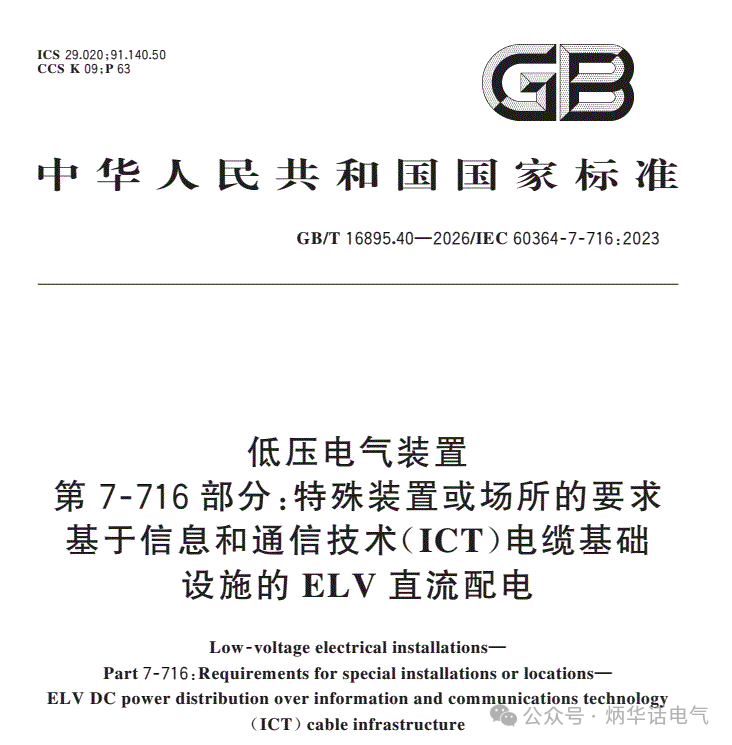
1. Core Scope of Application
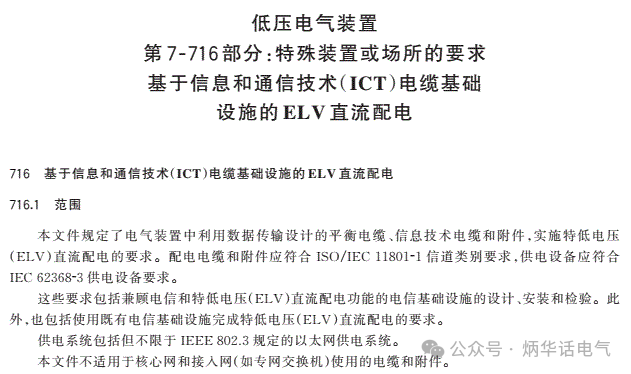
This document clearly specifies the technical requirements for implementing extra-low voltage (ELV) DC distribution using balanced cables designed for data transmission, information technology cables, and associated accessories. It covers the design, installation, and end-to-end inspection of such infrastructure that serves both telecommunications signal transmission and ELV DC distribution functions. It also regulates scenarios involving the retrofitting of existing telecommunications infrastructure to enable extra-low voltage DC distribution. The standard applies to common ICT power supply systems such as Power over Ethernet, but does not apply to cables and accessories used in core networks or access networks for private switches.
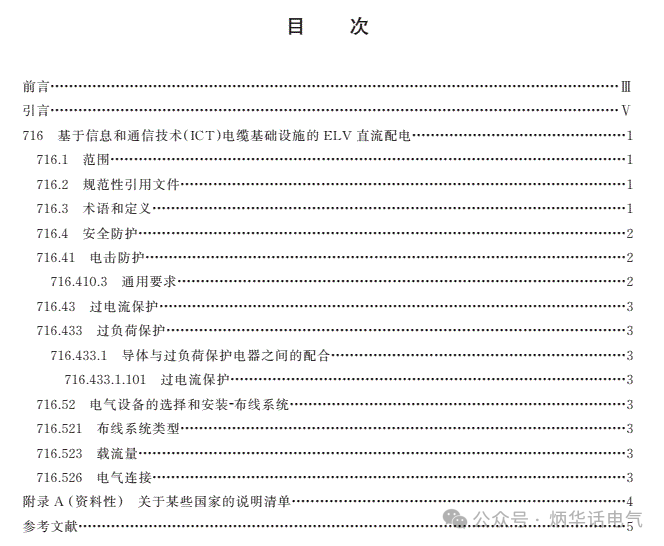
2. Core Technical Requirements
2.1 ICT Cabling Infrastructure Specifications
The standard stipulates that distribution cables and accessories must comply with the relevant channel category requirements of ISO/IEC 11801-1. It sets clear limits on cable ampacity, voltage drop, and insulation performance, prioritizing low-smoke halogen-free flame-retardant materials. Additionally, it mandates that ELV DC cables be installed in separate layers from AC power cables and ordinary signal cables, maintaining adequate safety clearances. Measures such as shielding grounding and node filtering are required to reduce electromagnetic interference risks, ensuring that signal transmission and power distribution do not affect each other.
2.2 System Design and Equipment Selection Requirements
Power supply equipment must meet the relevant requirements of IEC 62368-3. Systems may adopt centralized or distributed architectures, allowing adaptation of corresponding ELV DC voltage levels according to load type and transmission distance, balancing operational safety with transmission efficiency. For ICT scenarios requiring high reliability, the standard explicitly requires critical facilities to be equipped with N+1 or 2N redundant power systems to prevent single-point failures from causing power outages.
2.3 Comprehensive Safety Protection Rules
In view of the characteristic of DC distribution having no natural zero-crossing point, the standard specifically refines technical details for electric shock protection, overcurrent protection, and overload protection. It clarifies matching requirements between conductors and overload protective devices, mandating the use of DC-specific protective devices to achieve precise isolation of fault circuits. At the same time, strict minimum values are set for electrical clearances and creepage distances of isolation devices, reducing safety hazards posed by DC arcs.
2.4 Construction, Acceptance, and Operation & Maintenance Specifications
The standard provides clear guidance on wiring system installation routes, space reservations, bending radii, and heat dissipation conditions, requiring avoidance of high-temperature, humid, or mechanically vulnerable areas. Upon project completion, multiple tests and inspections must be carried out, including insulation performance, electromagnetic compatibility, and reliability of protective operations. It also provides a unified technical basis for subsequent routine operation and maintenance, as well as periodic compliance assessments.
The implementation of this standard will effectively promote resource integration of ICT infrastructure in scenarios such as data centers and smart buildings, reducing overall energy consumption of distribution systems while ensuring electrical safety, and providing unified compliant technical guidance for the DC upgrade of related industries.
Source: Binghua Talks Electrical, Author: Binghua Talks Electrical
China Light
The official website of the China Association of Lighting Industry and a full-media platform for the lighting sector. We provide authoritative and timely lighting information while striving to be a growth partner for businesses. From brand promotion and channel expansion to consulting, talent training and participation in standards development, we provide comprehensive professional services to help businesses improve quality and efficiency and jointly advance the high-quality development of the lighting industry.
Business Contacts
仇纯 (Ms.): 158 6155 3579
顾君 (Mr.): 137 7157 5253