
From Philips to Osram: Aotu Technology undergoes bankruptcy restructuring, with Osram set to take over!
On September 24, 2026, a notice posted on the National Enterprise Bankruptcy and Reorganization Case Information Network brought a long-dormant factory back into the industry spotlight—Aotu Technology (Hubei) Co., Ltd.’s administrator announced that Osram Corporate Management Co., Ltd. had been selected as the .
Many may be hearing about “Aotu Technology” for the first time, but it is far from new: its predecessor was Philips Automotive Lighting Hubei Co., Ltd., established in 1995; its Songzi plant was one of Philips’ earliest manufacturing bases in China’s automotive lighting sector; and the headlights it produced bore the "PHILIPS" brand.
This announcement has reverberated throughout China’s domestic automotive lighting supply chain. A company that grew out of Philips has ultimately entered Osram’s restructuring negotiations. This is no mere bankruptcy tidbit; behind it lies a profound reshuffling of the automotive lighting industry’s landscape.
Osram Selected, Restructuring Enters Its Second Half
On March 31, 2026, Aotu Technology (Hubei) Co., Ltd. (hereinafter referred to as Aotu) filed for bankruptcy reorganization with the Intermediate People’s Court of Jingzhou City, Hubei Province, citing a complete breakdown in its cash flow, continuously deteriorating operating conditions, and an obvious inability to repay maturing debts. According to the latest September announcement, during this round of investor recruitment, two competitors withdrew successively:
Yuxinfeng (Guangdong) Lighting Technology Co., Ltd. voluntarily withdrew;
Suprajit Engineering Limited failed to pay the due diligence deposit or arrange due diligence within the stipulated timeframe, so the administrator deemed it withdrawn.
Accordingly, Osram Corporate Management Co., Ltd. (the Chinese entity affiliated with ams OSRAM) was confirmed as the . The administrator stated that they would "directly negotiate specific matters such as the scope of investment, investment consideration, and terms of the restructuring investment agreement" with Osram.
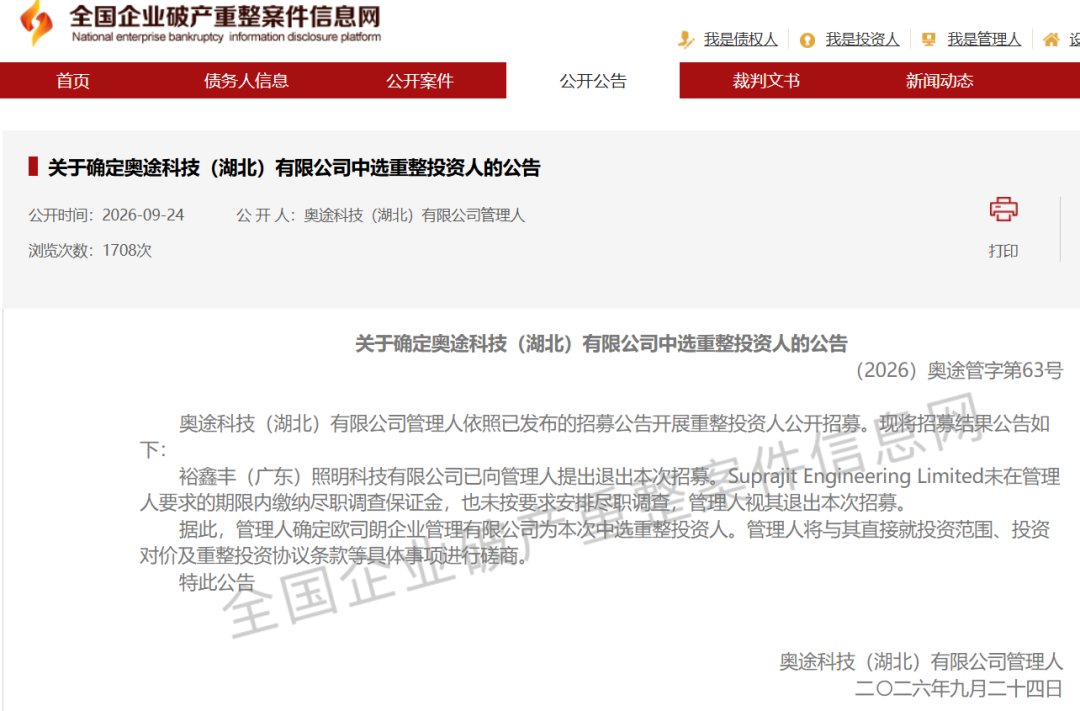
(Screenshot from: National Enterprise Bankruptcy and Reorganization Case Information Network)
However, . Nevertheless, Osram’s entry has essentially locked in the direction of this veteran factory’s rebirth.
No. 17 Philips Road: Thirty Years of Headlight History
Aotu Technology can be regarded as Philips’ “legacy” in automotive headlight manufacturing in China. At its peak, it held a 60% share of the domestic automotive OEM market and 25% of the aftermarket, with annual output value exceeding RMB 400 million.
Looking back at its history:
1 1995: The Starting Point of Sino-Foreign Joint Venture. Building on the former Hubei Automotive Bulb Factory, Dutch company Philips formed a joint venture with it, establishing Philips Automotive Lighting Hubei Co., Ltd., located at —so much so that the local area even named the road “Philips Road,”
2 2015: Philips Global Strategic Realignment, Renamed Lumileds. As Philips spun off its automotive lighting components business into Lumileds, the Hubei plant was subsequently renamed Lumileds Technology (Hubei) Co., Ltd. By then, it had already become a key domestic manufacturing and R&D hub for automotive lighting.
3 2024: Lumileds Sells Off Its Automotive Lighting Business. In May 2024, Lumileds announced the sale of its “automotive lighting and aftermarket business” to U.S. automotive aftermarket giant FBG for US$238 million.
4 2025: Renamed Aotu. FBG established a Dutch holding entity Ultinon Motion Holding B.V., which wholly owns the domestic entity; the domestic company officially changed its name to Aotu Technology (Hubei) Co., Ltd., adopting the Ultinon brand. Its business units include the Songzi plant in Hubei, China, and the Shanghai branch, with products , focusing on automotive lighting and accessories.
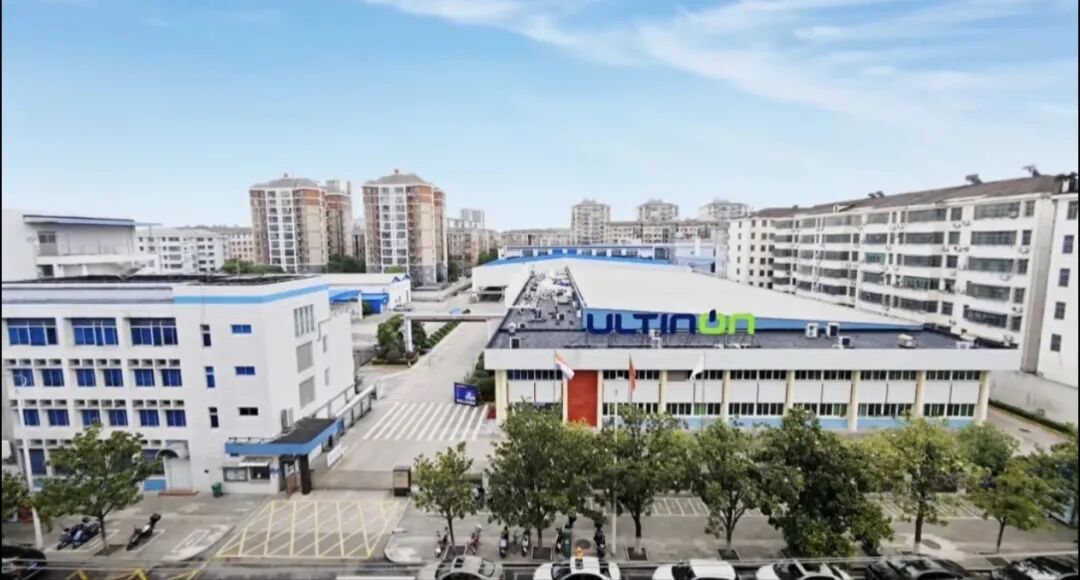
Notably, in 2025, Aotu Technology’s Songzi plant also celebrated its 30th anniversary. The Songzi plant serves as Aotu’s primary production base; beyond factory facilities, what it possesses most preciously are .
According to Civil Ruling No. (2026) E 10 Po Shen 1 issued by the Intermediate People’s Court of Jingzhou City, Hubei Province, as of January 31, 2026:
Total assets amounted to approximately RMB 809 million, total liabilities to approximately RMB 336 million, and book net assets to approximately RMB 473 million;
However, reached as high as RMB 651 million, of which RMB 645 million was owed by a Hong Kong affiliate under the same group, Ultinon Motion Hong Kong Co. Ltd;
And this Hong Kong company had already convened a creditors’ meeting on April 1, 2026, ;
The company’s stood at only RMB 5.506 million, while maturing debts totaled RMB 153 million.
In other words, “excluding the highly unlikely-to-be-collected RMB 645 million in accounts receivable, the company’s actual net worth could be as low as negative RMB 172 million.” The court’s assessment hit the nail on the head: “ compounded by a insufficient to cover maturing debts, the company meets the grounds for bankruptcy. At the same time, Aotu Hubei possesses complete core assets, and its profitability and operational capabilities over the past three years have remained relatively stable, indicating restructuring value.”
Even more critical was the . In September 2025, the U.S.-based FBG Group filed for bankruptcy protection; in March 2026, Aotu’s sole shareholder, Ultinon Motion Holding B.V., initiated Chapter 11 reorganization in the U.S. and instructed the Chinese entity to simultaneously apply for bankruptcy or restructuring.
FBG’s collapse dragged down the distant Songzi plant in Hubei to some extent, representing a typical case of overseas parent company debt crisis spilling over to domestic entities—not that the Songzi plant had completely lost its ability to operate. The announcement explicitly notes that after restructuring acceptance, , and business did not grind to a halt.
In the automotive lighting sector, Osram is an undisputed “veteran powerhouse,” boasting deep technical expertise in automotive LED light sources, core components for pixel headlights, ADB intelligent headlight solutions, and full-vehicle front-end lighting integration. Meanwhile, Aotu Technology’s original business leaned more toward the global automotive aftermarket replacement headlight market, making the two portfolios complementary.
With Osram set to take over a “Philips-affiliated” factory, we can anticipate certain reasons and changes:
1 Strengthening the Manufacturing Base. Osram excels in branding, chips, and optics, but a mature headlight factory like Songzi—certified to IATF 16949, with a complaint rate of 1PPM and 99% delivery accuracy—is a tangible asset. Acquiring it equates to gaining a ready-made, compliant, high-yield vehicle light source manufacturing base in China.
2 Harvesting Aftermarket Channels. Aotu Technology controls an extensive network of automotive aftermarket customers, certifications, and distributors. If Osram integrates these into its own brand system, it can directly expand its aftermarket share in China.
Furthermore, Osram operates an LED base in Wuxi and an R&D center in Shanghai. Revitalizing the Songzi plant through restructuring would create a closed-loop ecosystem of “front-end optoelectronic chips—vehicle assembly—aftermarket light source manufacturing.”
In the global automotive lighting market, Philips and Osram have long formed a foreign-invested duopoly. Should Osram truly secure the important manufacturing and channel assets of Philips-affiliated headlights, , signifying deeper consolidation of premium manufacturing resources within the foreign camp and intensifying competition in China’s automotive headlight market.
Aotu previously manufactured under the Philips brand for thirty years. Post-restructuring, if Osram completes the investment agreement signing, whether and under which entity brand authorization will continue deserves close attention.
From the Hubei bulb factory of 1995, through Philips, Lumileds, and Aotu, to Osram’s potential takeover in 2026—the Songzi plant’s thirty-year journey epitomizes China’s automotive lighting evolution: “introduction, growth, turbulence, rebirth.”
The cards are being reshuffled in the automotive aftermarket. For the LED lighting industry, beyond the game itself, there remains a harsh reminder—
China Light
The official website of the China Association of Lighting Industry and a full-media platform for the lighting sector. We provide authoritative and timely lighting information while striving to be a growth partner for businesses. From brand promotion and channel expansion to consulting, talent training and participation in standards development, we provide comprehensive professional services to help businesses improve quality and efficiency and jointly advance the high-quality development of the lighting industry.
Business Contacts
仇纯 (Ms.): 158 6155 3579
顾君 (Mr.): 137 7157 5253