
Taizhou Sports Center Natatorium Lighting Solution
Specificity of Natatorium Lighting
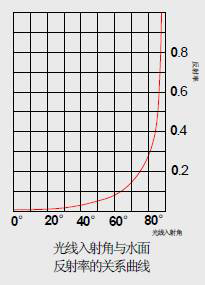
1. The biggest challenge in swimming pool lighting, compared to other types of lighting, is how to control the veiling reflection on the water surface. Veiling reflections on the water surface can cause many hazards to people; therefore, the installation of luminaires must ensure no visual interference, guaranteeing the best effect for viewing competitions. On the swimming pool water surface, the ratio of light reflection and transmission depends on the angle of incidence of light as shown in the figure on the right.
2. A swimming pool is not a precision work environment; for swimmers, the primary purpose of swimming pool lighting is to provide safety assurance. Therefore, swimming pool lighting must meet the following requirements:
(1) Lifeguards must be able to clearly see swimmers in distress. This can be achieved by limiting reflected light from the water surface and ensuring compliant horizontal illuminance.
(2) During swimming competitions, when athletes touch the pool wall, referees and spectators must be able to clearly see the touch action so that referees can make accurate judgments.
(3) For major events, vertical illuminance values and their uniformity must meet the requirements for color television broadcasting.
3. High-luminance glare on walls must be avoided, as high-luminance walls are more likely to cause reflected glare on the swimming pool water surface.
4. Special requirements for light sources and luminaires:
(1) In accordance with the requirements of the International Commission on Illumination (CIE), swimming pool lighting should, in principle, use light sources with high color rendering. At the same time, due to the large number of luminaires and considering energy saving requirements, light sources with high efficiency and long lifespan should be used as much as possible.
(2) The indoor swimming pool environment is characterized by high temperature, humidity, and chemical corrosion. Luminaires must be able to withstand this adverse environment, and maintenance differs from outdoor applications. Lighting for swimming pool competition areas should use fully sealed luminaires to prevent dust accumulation on the light source and optical reflector. In the event of bulb breakage, glass fragments will remain inside the luminaire, preventing injury. Due to humidity and condensation, the ingress protection rating of the luminaires must be at least IP23, and the luminaires themselves should have anti-corrosion measures. Luminaires with different light distributions should be selected based on the required projection distance.[NT:PAGE]
Design Background
Taizhou Sports Center is located at the southwestern end of the main axis of Taizhou's city center, covering an area of 523 mu. It borders the Taizhou Higher Education Park to the north, is close to the Sports Park to the west, and faces the Central Park to the northeast. The main construction content of the Sports Center includes one stadium and three arenas along with corresponding comprehensive supporting facilities, namely the main stadium, tennis court area, gymnasium area, swimming hall, and supporting facilities such as the athletes' club, outdoor track and field, and ball game training grounds.
This project is a sub-project of it. The swimming hall is located in the southwest corner of the City Sports Center. It contains one 50m x 26m (10 lanes) swimming pool, one 25m x 25m diving pool, one 50m x 10m training pool, and one accompanying relaxation pool. The competition area (swimming and diving) has 2,000 spectator seats.
Venue Features
1. Comprehensive modes: From a design perspective, the venue's lighting design simultaneously meets the lighting requirements for swimming competitions or training under various conditions, as well as for normal operational modes.
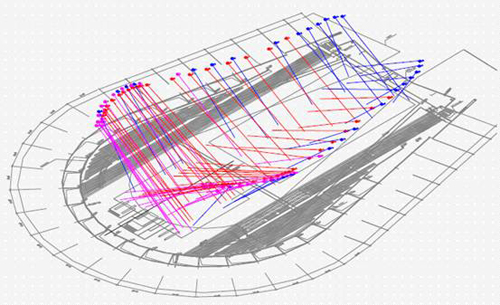
2. Special catwalks: Due to constraints imposed by the architectural structure of the entire swimming venue, the catwalk configuration differs from the usual—forming a "horseshoe" shape in the horizontal direction, with varying heights at each point and different distances from the pool edge.
Design Explanation:
(1) Addressing the specific characteristics of swimming, starting from the three different requirements of athletes, spectators, and cameras
Indoor swimming competitions are intense and tense events. The uniformity of horizontal illuminance on the lanes is the most critical factor, and lighting gradients must also be well controlled. This prevents the "zebra effect" during the competition.
(2) In addition to horizontal illuminance, vertical illuminance must also be considered for spectators and cameras. Relatively uniform vertical illuminance provides good conditions for viewing and broadcasting.
According to the tender requirements, we adopt a combination of parallel lighting arrangement along the lighting bridge and cross lighting arrangement. Parallel lighting ensures horizontal illuminance on the lanes, while cross lighting ensures vertical illuminance and lighting in the central area of the venue.
Technical standards and specifications adopted in the design
1. National Standard GBJ133-90 Standard for Lighting Design of Civil Buildings
2. National Standard JGJ/16-92 Code for Electrical Design of Civil Buildings
3. CIE International Lighting Design Standards
4. Relevant technical standards of World Aquatics (formerly FINA)
5. Tender requirements[NT:PAGE]
Human-centered design tailored to the specific characteristics of swimming
1. Control of light angles. Pay special attention to the glare impact on athletes and the viewing experience of spectators. During lighting design, strictly control most light incidence angles to within 50 degrees, minimize light parallel to the track, and reduce the impact on athletes to a minimum; light directed towards the spectator stands must be strictly controlled within 45 degrees to minimize the impact on spectators.
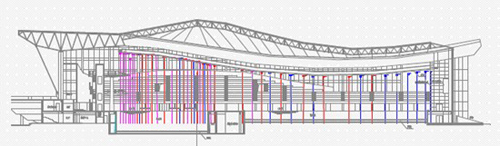
Cross-sectional view of luminaire layout along the track
For the diving platform area of the diving pool, control the incidence angle between 50 and 60 degrees. This prevents reflections from the water surface from adversely affecting athletes while minimizing the impact of light on spectators. At the same time, different incidence angles ensure reasonable vertical illuminance and horizontal illuminance for diving platforms at different heights.
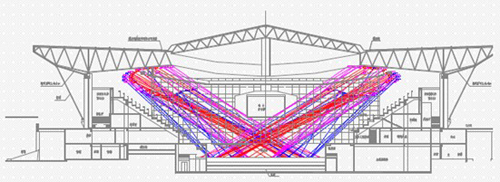
2. Keep luminaire light away from walls as much as possible to avoid forming large areas of glare on the walls, which can cause visual and psychological impacts on athletes, referees, and spectators.
3. Considerations for the特殊性 of luminaires and light sources
(1) The lighting design for this swimming pool competition venue fully utilizes high-quality THORN sports luminaires. Excellent glare control, diverse light distribution options, and perfect ingress protection (IP rating) ensure that MUNDIAL fully meets all requirements for the swimming pool lighting.
(2) The light sources are energy-saving and highly efficient OSRAM double-ended 1000W metal halide lamps. Their good color rendering, luminous efficacy, and color temperature fully meet the tender requirements.
For specific parameters of the luminaires and light sources, please refer to the attached page.
4. Luminaire layout for the training pool
Considering the architectural features of the training hall, we use THORN multifunctional 400W floodlights (OTMH) for the training pool lighting, adopting a single-side wall mounting arrangement to meet the horizontal illuminance requirement (200 lux) for general training.[NT:PAGE]
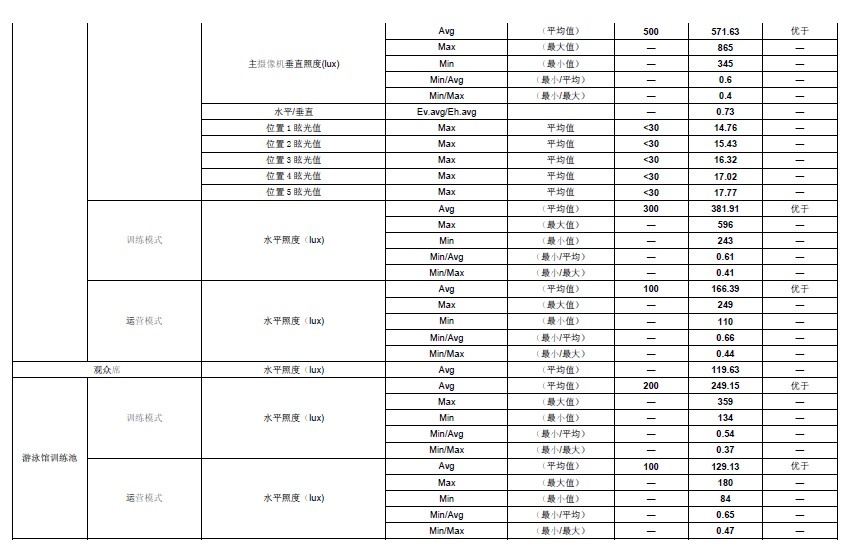
Performance Comparison Table of Illuminance Design Values for Swimming Pools and Training Halls
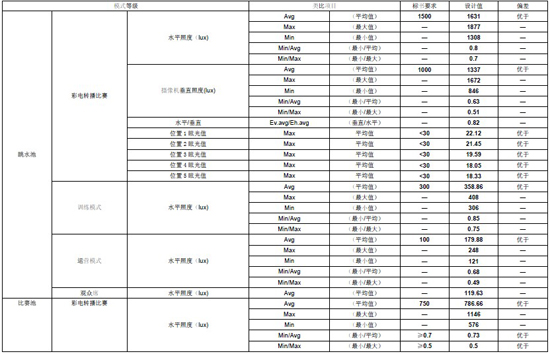
Large image: http://image.alighting.cn/2011/5/16/634411423090625000.jpg
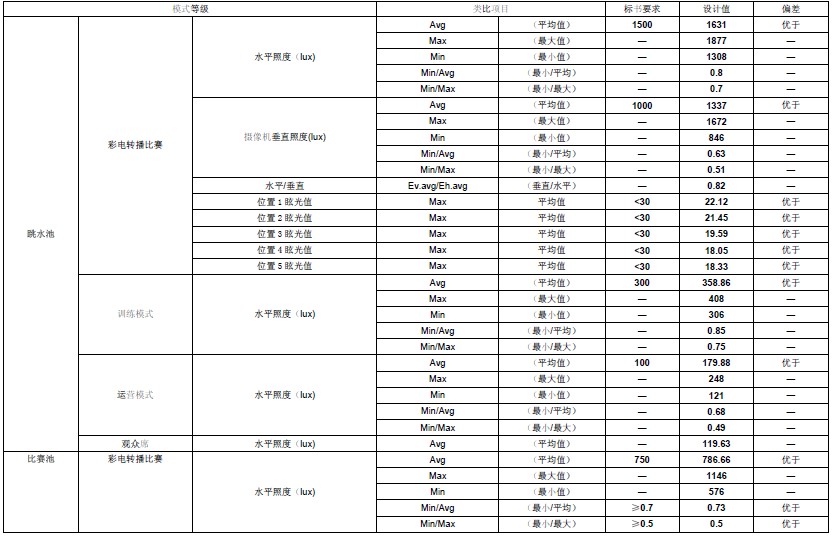
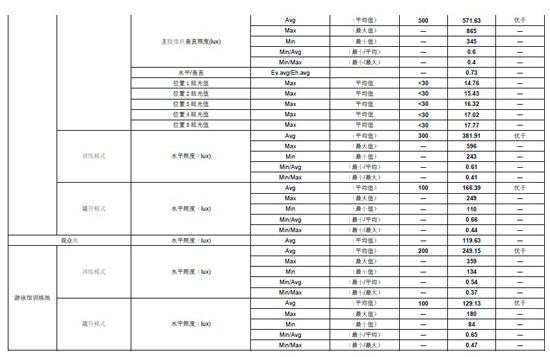
Large image: http://image.alighting.cn/2011/5/16/634411423982968750.jpg
Statistics on the Number and Power of Lamps Used in Various Venues and Modes
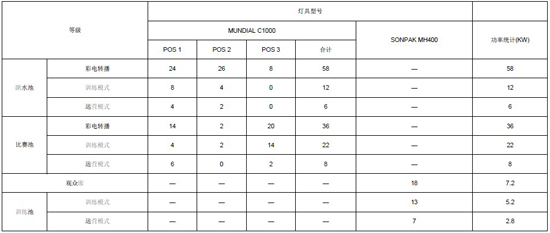
Large image: http://image.alighting.cn/2011/5/16/634411426320000000.jpg[NT:PAGE]

High-quality luminaires:
Using high-quality luminaires achieves both high efficiency and optimal glare control through the best combination of light source, reflector, and anti-glare louvers. Light is strictly controlled to produce a distinct cutoff line on the ground, ensuring effective glare control. Luminaire efficiency reaches up to 80%. The light source luminous efficacy reaches 90 lm/W. The overall luminaire efficiency is high.
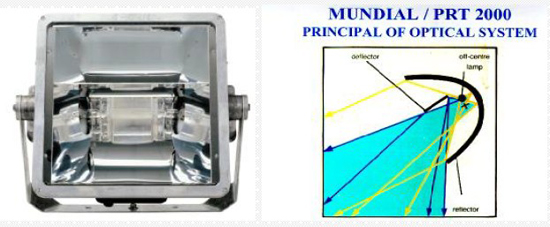
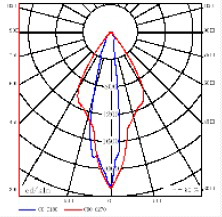
Unique performance:
A single reflector can provide narrow, medium, and wide beam distributions by adjusting the light source to three positions. This facilitates on-site installation and adjustment. It has performed excellently in the Sydney Olympics and many other major competitions.
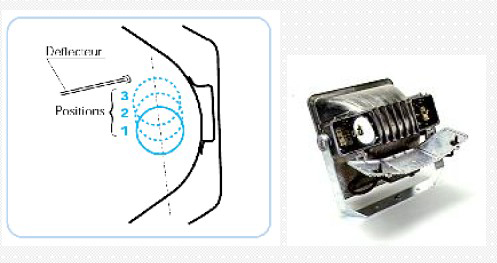
Rear cover access protection. Power-off maintenance is completed by opening the rear cover.
First, it ensures consistency of the aiming point.
Second, power off to ensure staff safety.
Class II electrical rating for enhanced safety.
Detailed Introduction
1.1 Luminaire Introduction
Cat. No.: MUNDIAL C1000
Model
Lamp: HQI-BT1000/D Metal halide lamp
Light source: OSRAM 1000W Metal halide lamp
Luminous flux: 80000lm
Color temperature: 5600K
Color rendering: ≥90
Description: Mundial 1KW linear metal halide floodlight, die-cast
Description: aluminum body with cylindrical parabolic optical system,
baffle with three lamp positions, rear access to the lamp
with automatic power interruption. IP65, class II insulation
Mundial 1000W metal halide flood lamp, die-cast aluminum housing, cylindrical parabolic shape
Reflector, three light source positions produce three light distributions, IP65, Class II electrical rating
Body: Die cast aluminium
Lamp body
Reflector: Asymmetric specular anodized aluminum reflector
Asymmetric anodized aluminum reflector
Anti-glare baffle: High-purity aluminum, excellent glare control.
Front window: Tempered glass
Sight: Double sight
Light distribution: Three beam angles, narrow, medium, wide
Power factor (PF): >90%
Manufacturer: THORN Lighting
Origin: European E.C.
 [NT:PAGE]
Cat. No.: OT400MH
Model
Lamp: HQI-T 400/N Metal halide, E40 base
Light source: OSRAM 400W metal halide light source, E40 lamp cap
Luminous flux: 32000 lm
Color temperature 4000K
Color rendering ≥65
Description Sonpak 40 Enclosed white LM6 aluminium floodlight with
toughened glass front and integral control gear for Metal
Halide lamp. Mounted on adjustable steel stirrup. Sealed to
IP65. As Thorn Sonpak 40.
Sonpak 40 white LM6 die-cast aluminium flood lamp, with tempered front glass and built-in
ballast, with 400W metal halide lamp; mounted on an adjustable iron bracket,
Ingress protection (IP rating) IP65.
Body: Recyclable pressure die-cast LM6 aluminium body finished
White die-cast aluminum lamp body
Lens: Toughened soda lime glass
Fixing bolts: Stainless steel
Locking screws: Stainless steel
Gasket: Silicone rubber
Reflector: Dimpled anodised aluminium
Reflector: Anodized aluminum
Stirrup bracket: 5mm zinc plated steel, white finish
Power factor (PF): >90%
Manufacturer: THORN Lighting
Origins: China
 [NT:PAGE]
SONPAK 400MH
Integrated luminaire body: Integrated design of electrical components and luminaire body, simple and flexible installation;
High ingress protection (IP rating): IP65. The sealing of the luminaire body is not between glass and metal, but between the metal front cover and the metal luminaire body, offering much higher reliability. Moreover, maintenance is simple, and issues with sealing due to front cover damage will not occur;
Excellent light distribution: Asymmetric wide beam output, combined with tiered seating, ensures uniform illumination of the audience area.
Rational luminaire design: Since the light source and electrical components are housed within a single luminaire body, temperature control is crucial. In addition to using aluminum with good heat dissipation for the housing, the electrical components are arranged reasonably to maximize the lifespan of both the light source and the electrical components.
Electrical Component Introduction
Electrical components: Tw=150°C, Δt=55°C, ensuring a service life of 20 years.
Die-cast aluminum electrical box, IP65, with good heat dissipation and dust protection.
Light Source Introduction
OSRAM double-ended short-arc metal halide lamps offer the following advantages:
High luminaire efficiency: Due to the small light-emitting point, more luminous flux can be reflected. Combined with a highly efficient lamp body, the overall luminaire efficiency reaches 80%;
Good glare control: Compared to large bulb-shaped light sources, the smaller emitter results in significantly less glare.
Good color temperature and high color rendering:
Excellent light distribution: The light distribution produced by combining this light source with the luminaire is suitable for gymnasiums with high catwalks, and it is especially recommended for Olympic-level venues.
Equipment List and Main Technical Parameters
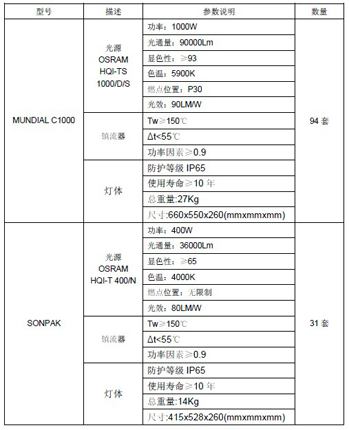
Large image: http://image.alighting.cn/2011/5/16/634411436065781250.jpg
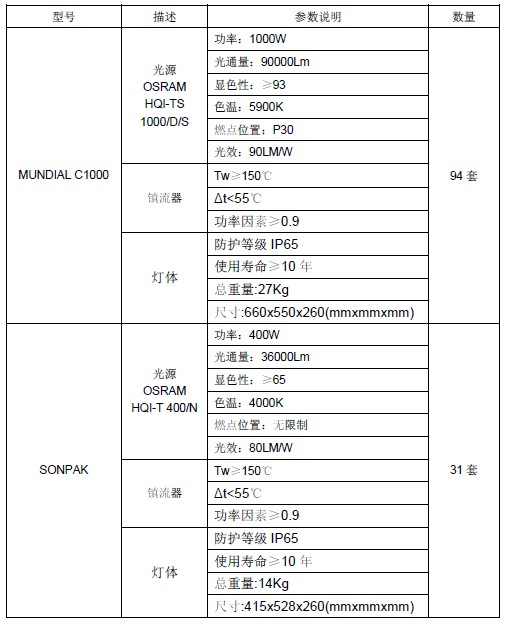
China Light
The official website of the China Association of Lighting Industry and a full-media platform for the lighting sector. We provide authoritative and timely lighting information while striving to be a growth partner for businesses. From brand promotion and channel expansion to consulting, talent training and participation in standards development, we provide comprehensive professional services to help businesses improve quality and efficiency and jointly advance the high-quality development of the lighting industry.
Business Contacts
仇纯 (Ms.): 158 6155 3579
顾君 (Mr.): 137 7157 5253