
Schluss mit dem Wettlauf um immer höhere Parameterwerte! Feng Jian erklärt die neuen Ansätze und Umsetzungsstrategien für gesundes Licht – inklusive eines Leitfadens zur Vermeidung von Fehlern bei der Ausstattung.
On September 16, the “Ancient Town Lighting Expo – Bright Minds Online” salon, hosted by Zhongshan Ancient Town Light City Expo Co., Ltd. and organized by China Zhi Guang All-Media & Ming Classroom, kicked off online. This session featured Mr. Feng Jian, Vice President of the Henan Provincial Illumination Society and a senior lighting designer, who outlined the theoretical framework and practical project approaches for healthy lighting, focusing on the industry’s transformation from an “energy efficiency revolution” to a “human-centered light environment revolution.”
A Shift in Thinking:
From “Selling Luminous Flux” to “Delivering Verifiable Light”
Mr. Feng Jian pointed out that historically, the industry has focused on selling lamp specifications and competing based on luminous flux, with design decisions often reduced to “this area is too dark—add more light,” or “selling lamps and making them bright is enough to create value.” As requirements such as low blue light have become mandatory, the market is shifting toward a people-centric approach: designs must deliver tangible, verifiable health benefits to real spaces and individuals.
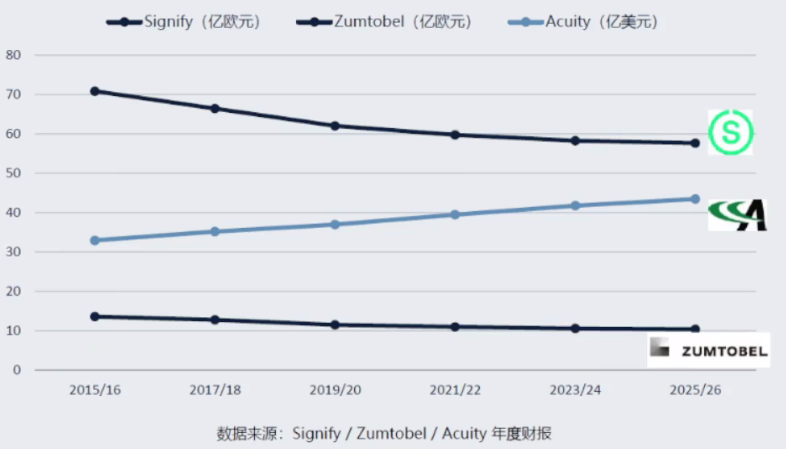
Ten-Year Revenue Trends of the Three Major Players
The Scientific Foundation:
The Four Value Quadrants of Healthy Light
A qualified beam of light must pass the test of four key quadrants: Health, which addresses circadian lighting and melatonin; Sustainability, covering the full lifecycle, carbon neutrality, and recyclability; Productivity, focusing on concentration and work efficiency; and Emotion, influencing ambiance, social interaction, and emotional memory. Traditional national and industry standards typically cover only lamp‑level parameters like illuminance, efficacy, glare, and color rendering index, leaving out the crucial question: “What impact does light actually have on people?”
What Kind of Light Suits This Particular Person?
We Must Start Understanding People
The new national standard GB/T 46119-2025 “Dose of Non-Visual Biological Effects of Light on the Human Eye” fills this gap, highlighting two particularly critical metrics:
m-EDI (Melanopsin Equivalent Illuminance under D65 Daylight): Measured according to vertical eye position measurements, at 1.2 meters when seated and 1.5 meters when standing—rather than the traditional 75 cm working surface. A handheld spectroradiometer is required; ordinary illuminometers cannot measure it.
CS (Circadian Stimulus): Ranges from 0 to 1, reflecting the strength of nighttime melatonin suppression.
For example, in a bedroom, three hours before sleep, m-EDI should be below 10 lx and CS below 0.1. Exceeding these thresholds can disrupt melatonin secretion and impair sleep—findings derived from extensive surveys of Chinese populations.
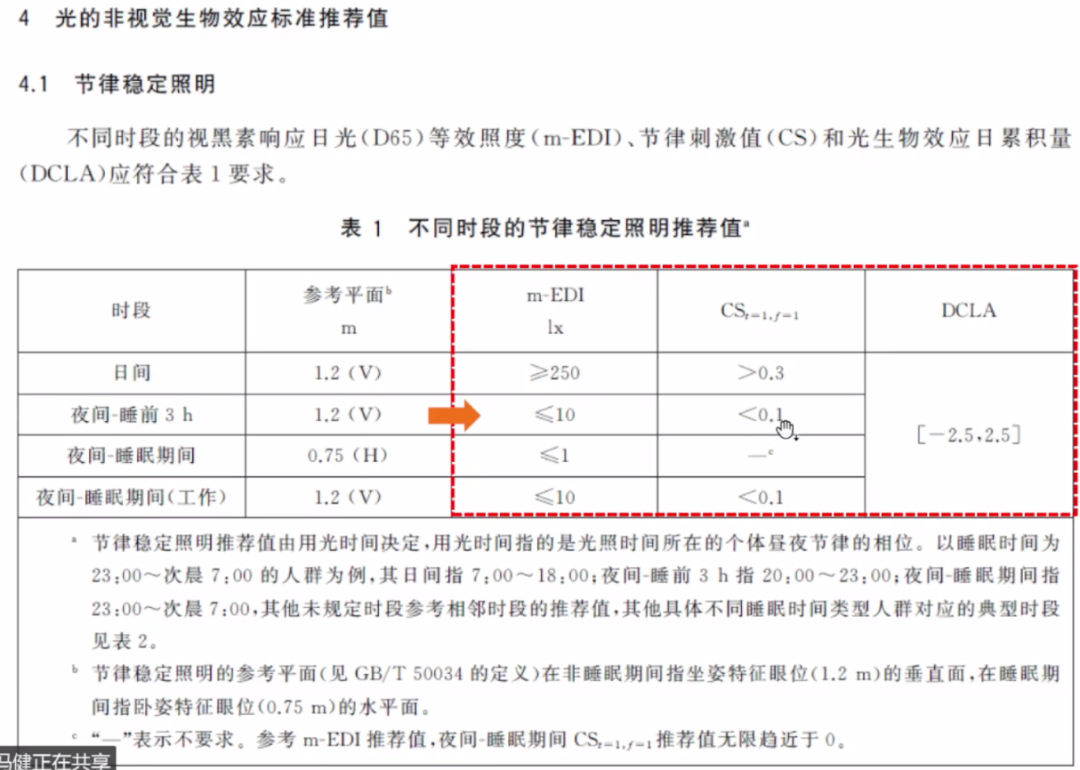
Recommended Values from GB/T 46119-2025 “Dose of Non-Visual Biological Effects of Light on the Human Eye”
Mr. Feng emphasized that healthy lighting must form a closed loop:
Healthy Lighting Chain:
Light Environment Design + Human Physiological Response → Health Benefits → Continuous Optimization.
Smart Lighting Chain:
Device Connectivity + Data Sensing → Intelligent Decision-Making → Execution Feedback.
If any link in the chain is broken, healthy lighting becomes nothing more than marketing jargon, and smart lighting is merely pseudo‑intelligence with Wi‑Fi added.
Home Design:
24-Hour Light Recipes
In response to modern lifestyles—insufficient daylight during the day and disruptive blue light from screens at night—Mr. Feng Jian proposed dynamically adjusting the light environment according to daily cycles:
6:30–9:00 AM: Cool white light to help the body wake up quickly.
9:00 AM–5:00 PM: Comfortable illuminance and color rendering to support productivity.
5:00–9:00 PM: Warm light around 3000–3500K to create a cozy atmosphere.
9:00 PM–11:00 PM: Lower color temperature (below 2000K) and controlled m-EDI levels to minimize sleep disruption.
Late Night: Extremely low color temperature to ensure elderly users aren’t startled by bright lights when getting up at night.
Design Insights
Truly intelligent lighting environments go beyond simple switches or dimming—they follow the body’s circadian rhythm, crafting a “light script” tailored to each moment. Traditional solutions often overlook the special lighting needs of bedtime and nighttime, which are among the hidden factors affecting modern sleep quality.
For elderly individuals getting up at night, he offered five key recommendations: reduce vertical illuminance at eye level to 1.2 meters; avoid direct light shining into the eyes; minimize overhead lighting and prioritize deep anti-glare fixtures (no exposed downlights); use more low‑lying, indirect, soft light sources; and maintain continuous lighting along the nighttime pathway to eliminate dark spots and reduce fall risks.
Mr. Feng also reminded everyone that blue light doesn’t need to be demonized—it’s essential during the day, and moderate exposure in office settings can even enhance focus. Strict control is only needed at night to protect sleep.

Key Wavelength Highlight: 460–490 nm Short-Wave Blue Light ((the core range with the greatest impact))
He also provided a five‑question self‑checklist for home lighting—covering time‑based zoning, pre‑sleep m-EDI values, nighttime pathways, transitions between study and bedtime, and coordination between nighttime screens and end‑systems—as a self‑assessment tool for designers. Both this checklist and the aforementioned new national standard are recommendatory, not mandatory.
Commercial Space Design:
Four Major Scenarios + Construction Pitfalls to Avoid
Commercial space design draws on the WELL Building Standard, covering offices, healthcare facilities, hotels, and wellness centers. For instance, in office environments, simply meeting 300 lx at the desk isn’t enough; sufficient vertical illuminance at eye level must be maintained throughout the day, with localized boosts above 800 lx during the afternoon slump to combat fatigue. Healthcare and wellness spaces, meanwhile, emphasize circadian lighting.
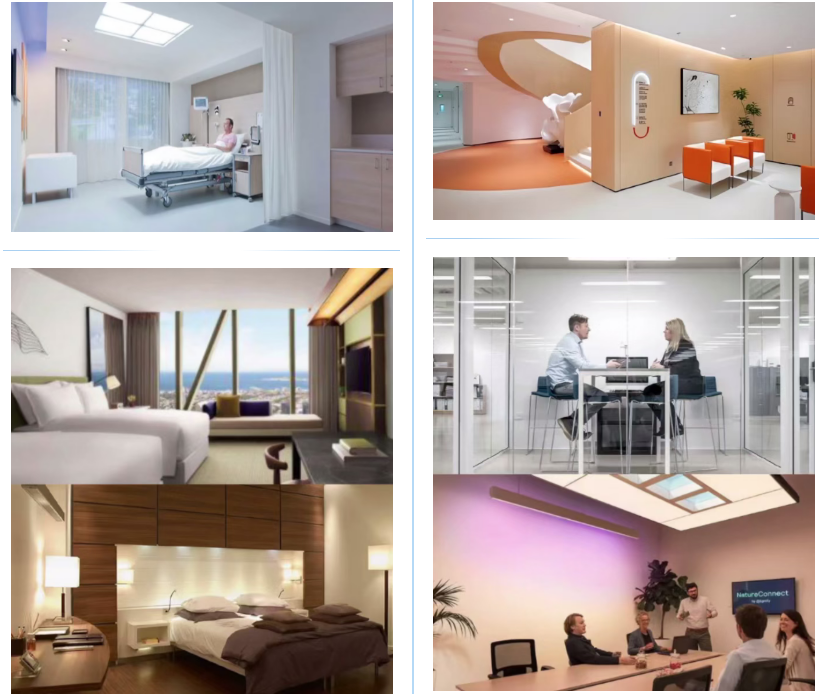
Top left: Benchmark Case: Suzhou Sukang Senior Care Hospital’s Circadian Ward
Top right: inSona Suzhou Sukang Senior Care Hospital (Circadian Ward)
Bottom left: Tangguo Shanghai High‑End Residential Project
Bottom right: Signify 5A Office Building
Common construction pitfalls include: uncontrolled color tolerance, ignoring environmental reflections when calculating luminaire performance, furniture and soft furnishings obstructing light paths, and adjusting only brightness without coordinating timing.
Mr. Feng suggested source‑level controls—quantifying color tolerance, m-EDI, and other indicators in tender documents; requiring all luminaires in the same batch to undergo sample sealing, arrival inspection, and strict rejection of non‑conforming units—to achieve comprehensive oversight across pre‑, mid‑, and post‑construction phases. In benchmark projects such as Suzhou Sukang Senior Care Hospital’s Circadian Ward, high‑end residences, and 5A‑grade office buildings, he successfully implemented circadian lighting and conducted rigorous on‑site verification.
Five Actions Designers Can Implement This Week
Include non‑visual metrics like m-EDI and CS in your proposals to strengthen persuasiveness.
Clearly specify technical requirements in contracts, including SPD spectra, timing, and light distribution curves.
Bring a spectroradiometer to acceptance testing for on‑site measurements.
Consider hard and soft finishes in advance to anticipate light loss.
Strengthen on‑site commissioning and project management to ensure consistent implementation of design outcomes.
Interactive Q&A
During the salon’s interactive session, Mr. Feng Jian addressed audience questions:
1. Are the “five‑question self‑checklist” for homes and the “construction acceptance checklist” mandatory or recommended?
Mr. Feng: They’re recommended—not mandatory—and GB/T 46119-2025 is likewise a recommendatory national standard. Incorporating these checklists into your proposals demonstrates a people‑centric approach and enhances persuasiveness.
2. How can we prevent common construction issues like uncontrolled color tolerance, furniture obstruction, and ineffective commissioning?
Mr. Feng: Control starts at the bidding stage: quantify all relevant indicators, including color tolerance and m-EDI; require luminaires from the same batch to minimize chip‑batch‑induced color variations; strictly seal samples, conduct arrival inspections, and reject non‑compliant units. Rigorous oversight across design, supply, and acceptance ensures alignment between drawings and actual installation.
3. How do we communicate the value of healthy light to clients and secure payment?
Mr. Feng: Integrate m-EDI, CS, flicker, melatonin‑related non‑visual effects, and color‑temperature timing controls into your proposals—don’t just showcase illuminance and color temperature. Deeply engage in procurement, use a spectroradiometer for on‑site measurements, and present quantifiable data to demonstrate value, ensuring consistency between design and implementation.
4. What if manufacturer’s sample test reports differ from on‑site measurements?
Mr. Feng: Manufacturer reports assess the luminaire itself, while on‑site tests measure human eye‑level reception, influenced by installation methods and environmental reflections. First determine whether the discrepancy stems from the fixture or the installation process; if the issue persists after adjustment, collaborate with the manufacturer to resolve compatibility problems.
5. Which steps should novice designers prioritize to put healthy lighting principles into practice?
Mr. Feng: Master current national lighting standards first, then become proficient in design software such as DIALux evo and Koolux. Use Koolux to simulate m-EDI and melanopsin equivalent illuminance, evaluating both work‑surface illumination and vertical eye‑level readings, while also considering LPD energy‑efficiency metrics. Listen, observe, and research extensively, gradually implementing these concepts in real projects.
Conclusion
The essence of this salon was to move healthy lighting from a mere marketing slogan to measurable, verifiable, and replicable engineering practices. Mr. Feng Jian redefined the criteria for judging a beam of light through the lens of four value quadrants, using m-EDI and CS indicators from the new national standard to remind us that the true value of light lies not in spec sheets but in the human eye‑level experience within real spaces. With a 24‑hour light recipe, a construction‑pitfall checklist, and three real‑world case studies, he demonstrated how “people‑centricity” can transcend abstract ideals and take root in every selection, every contract, and every spectroradiometer measurement.
From “selling luminous flux” to “delivering verifiable light”—this shift represents not only a change in technical metrics but also a fundamental change in designers’ mindset: light is no longer about illuminating a space—it’s about caring for the people who inhabit it. May this sharing serve as a fresh starting point for more professionals to reexamine their drawings and reimagine the light they create.
Note: This article is compiled from the recording of Mr. Feng Jian’s presentation titled “From ‘Selling Luminous Flux’ to ‘Delivering Verifiable Light,’” delivered on September 16, 2026, at Ming Classroom, and published by Ming Classroom.
China Light
Offizielle Website der China Association of Lighting Industry und umfassende Medienplattform der Beleuchtungsbranche. Wir bieten nicht nur verlässliche und zeitnahe Informationen zur Beleuchtung, sondern verstehen uns auch als Wachstumspartner für Unternehmen. Von Markenförderung und Kanalerweiterung über Beratung, Talentförderung und Mitarbeit an der Normung bis hin zu weiteren Leistungen bieten wir umfassende professionelle Services, damit Unternehmen Qualität und Effizienz steigern und gemeinsam die hochwertige Entwicklung der Beleuchtungsbranche vorantreiben können.
Kontakte für Kooperationen
仇纯 (Frau): 158 6155 3579
顾君 (Herr): 137 7157 5253